Salsa vs Bachata vs Merengue vs Cha Cha
The four core Latin dances compared side by side — tempo, count, feel, and which one is easiest to start with. A cheat sheet for total beginners.
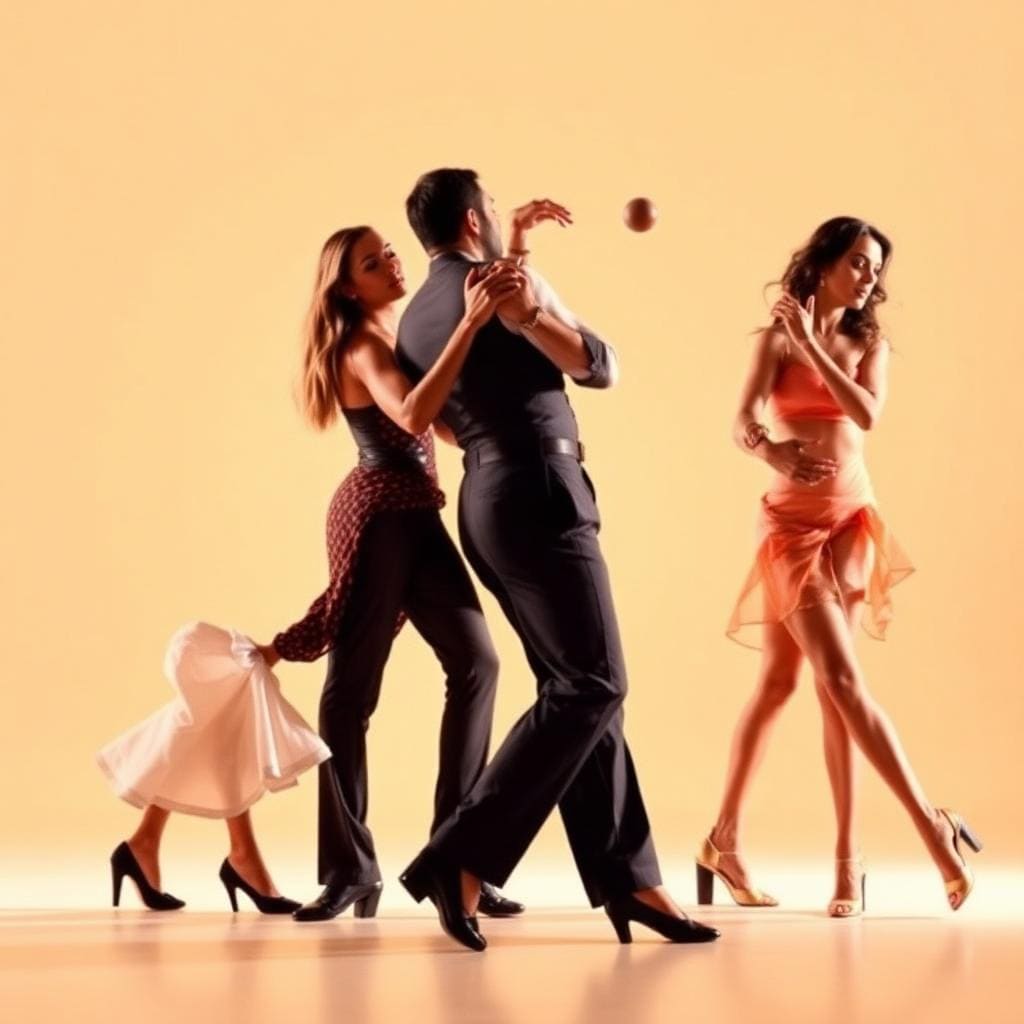
Walk into any Latin social night and you will hear four different feels back to back — a fast horn-driven salsa, a slow romantic bachata, a bouncy merengue and a snappy cha cha. All four are "Latin dance", but each one has its own count, tempo and personality. Here is the cheat sheet.
Salsa — 180-220 BPM, count of 8
Fast, syncopated, danced in a slot or in a circle. Steps on 1-2-3 with a pause on 4, then 5-6-7 with a pause on 8. The most technical of the four and the one social dancers spend the most years perfecting. Great for people who love musicality and turn patterns. Learn more in Salsa Level 1.
Bachata — 120-140 BPM, count of 8 with a tap
Smooth, sensual, and by far the easiest Latin dance to start with. Three steps to the side, tap-hip on 4 — repeat the other way. Danced across the world in Dominican, sensual and modern styles. Great for people who want a fun social dance without a steep learning curve. Start in Bachata Open Level.
Merengue — 120-160 BPM, count of 4
The easiest partner dance on earth. Step-step-step-step with a hip pop on every count. Almost impossible to be "off beat". This is the dance your instructor uses to teach frame, lead and follow without worrying about footwork. Learn it in Merengue class.
Cha Cha — 120-140 BPM, count of 8 with a triple step
The snappy cousin of salsa. Two slow steps and a quick triple: "1, 2, cha-cha-cha". Danced in a slot with hip action, playful attitude, and Latin ballroom styling. Great for people who like the crispness of a chassé and the sass of a hip pop.
Which should you learn first?
If you want the fastest win, start with bachata or merengue. If you want the hardest and most rewarding, start with salsa. If you want all four and a smooth introduction, take our Intro to Latin Rhythms class, a single 60-minute session that samples every style so you can pick your favorite.
Where cumbia fits
Cumbia is the fifth dance you will hear at any Las Vegas Latin night, and it is worth knowing how it sits against the four above. It rides a steady two-beat pulse at roughly 90 to 110 BPM, so there is no clave to find and no "where's the one" problem. Where salsa travels across a slot with cross-body leads and spins, cumbia rocks in place on a back-break basic and turns in slow circles. A cumbia couple can dance well in the space of a phone booth.
On difficulty it is the fastest of all of them: most people dance cumbia confidently at a party after one to three classes, against four to six weeks of consistent classes before salsa feels comfortable socially. The trade is vocabulary, since salsa keeps giving you new patterns for years.
The two also live in different rooms. Salsa dominates studio socials and Latin clubs, while cumbia dominates family parties, quinceañeras, weddings and the norteño and banda side of the city's music scene. Every good social night plays both, which is why most dancers here end up learning both. If your goal is Mexican family parties, start with cumbia. If it is the studio and club scene, start with Salsa Level 1.
Further reading: The full history of Latin dance, or the cumbia steps in detail.
Frequently Asked Questions
Is salsa or bachata easier to learn?
Bachata is easier to learn. Its basic step is a simple 4-count side-tap pattern at a moderate 120-140 BPM, while salsa runs on an 8-count pattern at a faster 180-220 BPM with more turn patterns to track. Most beginners feel comfortable with bachata's basic within one class; salsa's basic typically takes several classes to feel natural.
What's the difference between salsa and bachata?
Salsa is fast (180-220 BPM), danced on a count of 8 with a pause on 4 and 8, and travels across a slot or circle with frequent turns. Bachata is slower (120-140 BPM), danced on a count of 8 with a hip tap on 4, and stays mostly in place with a closer partner connection. Salsa is more technical and turn-heavy; bachata is more about rhythm and connection.
Should a beginner start with salsa or bachata?
Start with bachata if you want the fastest path to feeling comfortable on a social dance floor — most students get the basic in one class. Start with salsa if musicality and turn patterns are what excite you, even though the learning curve is longer. Many Las Vegas dancers do both: bachata first for quick wins, salsa second for the technical challenge.
Is cumbia or bachata easier to learn?
Both are considered the easiest Latin dances to start with, but cumbia has a slight edge. Its basic step is symmetrical and forgiving, and most dancers feel confident at a party after just 1 to 3 classes. Bachata's basic is also simple but requires a closer partner connection that takes a little more comfort to build.
What's the difference between cumbia and bachata?
Cumbia is danced in a looser, open frame with a steady two-beat rocking step around 90-110 BPM, and it's the dance of Mexican and Colombian family parties. Bachata holds a closer frame with a four-count side-tap pattern around 120-140 BPM, and it's more associated with romantic, couple-focused social dancing.
Should I learn cumbia or bachata first?
If your goal is dancing at Mexican family parties and quinceañeras, start with cumbia. If your goal is the broader Latin social-dance scene, start with bachata. Neither has a steep learning curve, so many dancers in Las Vegas end up learning both within their first couple of months.
Can I learn salsa and bachata at the same time?
Yes — the two styles use different muscle memory (salsa travels, bachata stays in place), so they don't interfere with each other. Our Intro to Latin Rhythms class teaches both in the same 60-minute session specifically because they reinforce different skills rather than competing for the same ones.
More Latin dance reading
- HistoryWhere Did Latin Dance Come From?The origin story of Latin partner dance — Cuban son, Dominican bachata, Puerto Rican bomba, and the New York fusion that gave the world salsa.
- TechniqueBasic Latin Dance StepsThe foundational step of every core Latin dance — salsa, bachata, merengue and cha cha — broken down count by count for total beginners.